Retail doesn't move markets. Institutions do.. and they don't post about it. I'm Hamilton. 17 years trading, three bear markets, still standing. Every morning before the open I show you where the big money's actually moving.. what it's buying, what it's leaving, and what I'm doing about it. 3 minutes, free. The next big move, we're in it instead of reading about it.
The Reflexivity Trap: Bearish Narratives & Doom Loops
|
Price moves first. The story comes second. That is the single most important thing I can teach you about markets. Yesterday Citrini Research published a piece called "The 2028 Global Intelligence Crisis." It's a thought experiment. What happens when AI replaces enough high income jobs that consumer spending collapses? Consumer spending is 70% of US GDP. If those people stop earning, they stop spending. And if they stop spending, it doesn't matter how productive the machines are. The money never circulates. GDP grows on paper. The real economy withers. In it, Citrini name drops Visa (V) and Mastercard (MA) as two companies likely to be hit the hardest over the next couple of years. It's a compelling read. But I don't want to debate whether AI will destroy jobs or whether productivity offsets the consumption loss. I'll leave that to the economists that seemingly never get anything right. I want to talk about something you can actually use right now. Visa and Mastercard Sucked Before The ArticleBoth peaked last summer. Both are down roughly 15% from those highs. Both broke their intermediate trends weeks ago. The price action was screaming distribution long before anyone published a 5,000 word article about AI destroying consumer spending. Now the narrative is catching up. And that's exactly how this works. Every single time. Soros Called It ReflexivityGeorge Soros built one of the greatest track records in the history of trading around one concept. He called it reflexivity. The idea is so simple that most people gloss right over it. Markets do not passively reflect reality. Markets are participants that actively shape it. In an uptrend, it looks like this: Prices rise. Rising prices create positive sentiment. Positive sentiment generates bullish narratives. Bullish narratives attract more buyers. More buyers push prices higher. The cycle repeats until prices overshoot any rational valuation and the buying simply runs out of fuel. The trend exhausts itself. Not because of bad news. Because the momentum can't sustain itself anymore. Then the whole thing flips. Prices fall. Falling prices create negative sentiment. Negative sentiment generates bearish narratives. Bearish narratives push more people to sell. More selling drives prices lower. The cycle repeats until prices undershoot any rational valuation and the last weak hand capitulates. New uptrends begin. Over and over. In every asset class. Across every time period. Price leads narrative. Narrative reinforces price. The loop overshoots in both directions. This isn't theory, by the way. It's observable. It's quantifiable. You can see it on any chart if you know what you're looking for. And it happens every market cycle. The Part Everyone Gets WrongVisa and Mastercard did not start falling because someone wrote an article about AI killing consumer spending. They started falling because institutional capital began rotating out months ago. The article came after. The narrative always comes after. And here's the thing. The Citrini piece is not the last bearish story you're going to hear about AI ending the world as we know it. There will be more. Each one will feel more convincing than the last. Each one may push prices a little lower. That's the reflexive loop doing its job. Downtrends attract negative narratives. Negative narratives accelerates the downtrend. Until all of a sudden.. the downtrend stops. The people reading that article right now and panic selling V and MA or any of the other names listed.. they're participating in the loop. They don't realize it, but they are the mechanism in which downtrends spiral out of control faster than people expect. How We Actually Use This Every DayIf you understand reflexivity, the playbook becomes very clear: We don't catch the falling knife. When price is trending down and bearish narratives are piling on, the loop is still running. Visa and Mastercard are in this phase right now. Let it play out. We wait for the loop to exhaust itself. How do we know when? The same way we always know. Price structure. Moving averages. Capital flow data. When institutional money stops leaving and starts coming back in, that's the signal that maybe it's time to start looking to buy again. Not a headline. Not a prediction. Not someone's opinion. The actual flow of capital. We position when the data confirms the turn. This is what our entire process is built for. When a beaten down sector, industry or stock flips from distribution to accumulation, we see it. Uptrends start rebuilding. Momentum shifts from deceleration to acceleration. Multiple independent signals all saying the same thing: the reflexive loop has reversed. Most people are reading the Citrini article and panicking about Skynet taking over the world. We're reading it and adding payment processors to the watch list, along with software, crypto and more, for when the reflexive loop bottoms out. The AI trade is far from over. Maybe we aren't buying today. Or this week. But when the data says it's time, we buy unapologetically. There's a great chance these trades are the best trades we put on all year. Screw popular consensus. Most people are dead wrong in the markets. That's the difference between following price and following prophets. Profits Over Prophets, Hamilton PS. Every week inside TTI, we break down exactly which sectors, industries, and individual stocks are leading.. and which ones to avoid. If you want the full playbook, including our live weekly Market Blueprint sessions and real time trade alerts, join us here. |
The Trading Initiative
Retail doesn't move markets. Institutions do.. and they don't post about it. I'm Hamilton. 17 years trading, three bear markets, still standing. Every morning before the open I show you where the big money's actually moving.. what it's buying, what it's leaving, and what I'm doing about it. 3 minutes, free. The next big move, we're in it instead of reading about it.
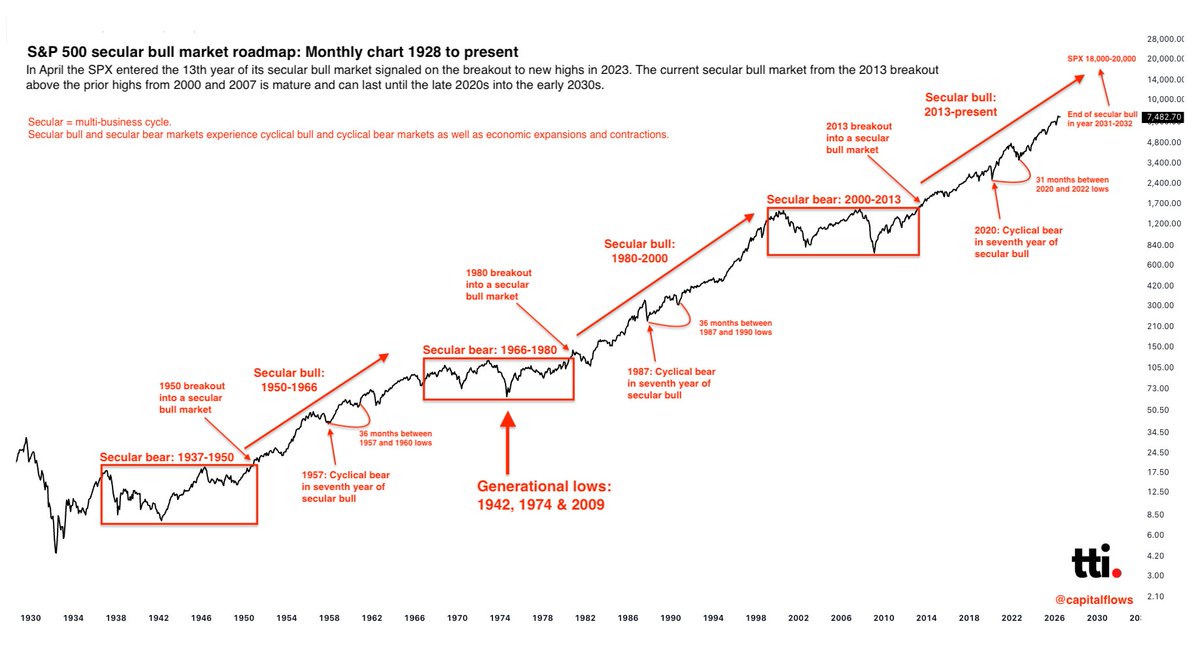
In Today’s Letter The S&P 500 has entered year 13 of its secular bull market. The last two secular bulls lasted 16 and 20 years. A bad storm doesn’t necessarily mean the season has changed. Every Sunday, I like to take a step back from the day-to-day market and think about the bigger picture. Not what might move tomorrow.. But what could shape markets for the next several quarters and years. The ideas that aren’t front and center. The questions most traders aren’t asking yet. This week,...
In Today’s Letter The Magnificent Seven are moving higher again. But they’ve trailed the S&P 500 since November. This week may be the first sign that leadership is changing. If the Magnificent Seven are so strong.. Why have they been losing to the rest of the market? That question might sound strange. After all, the Magnificent Seven have been moving higher for years. They’re some of the largest and most profitable companies in the world. And this week, they rallied nearly 4%. But going up...
In Today's Letter Bank earnings begin next week. Financial stocks are already making new all-time highs. The market may be telling us what to expect. Next week, the biggest banks in America report earnings. JPMorgan. Bank of America. Goldman Sachs. Wells Fargo. By next Friday afternoon, every financial news outlet will tell you who beat estimates and who didn't. But here's the question I can't stop thinking about.. If traders were truly worried about bank earnings.. why are they buying bank...