Retail doesn't move markets. Institutions do.. and they don't post about it. I'm Hamilton. 17 years trading, three bear markets, still standing. Every morning before the open I show you where the big money's actually moving.. what it's buying, what it's leaving, and what I'm doing about it. 3 minutes, free. The next big move, we're in it instead of reading about it.
9 Weeks Up. It's Happened 13 Times Since 1950.
|
The S&P 500 just closed higher than it opened nine weeks in a row. Going back to 1950, that has happened only 13 other times. The rally off the late March low has run about 20% in those nine weeks. Fast, relentless, the kind of move that has people tweeting "too far, too fast." So Randy on our desk did what we always do when a bad feeling shows up.. he went to the data instead. Here's what those 13 prior streaks did next. A month after a nine week run, the S&P was higher 84% of the time, averaging +1.51% versus a normal month's +0.86%. Then it keeps going. Positive one month, three months, six months, and twelve months out. Every window. A year later the median gain was +13.55%, higher three years out of four. Look at the path, not just the endpoints. The average run doesn't drift sideways and hope.. it grinds higher, and it sits above where the market goes on a normal stretch for almost the entire six months. A rare signal, and a consistent one. Now here's the part that turns a history lesson into a position. History tells you what usually happens. But it does not tell you whether it's happening right now. For that, you follow the money. So we did. Saturday's Flow Report went out to members and showed exactly where capital moved last week, and it lined up with the signal almost too perfectly. Into stocks. A lot of them. $22.2 billion flooded into US large cap equity in a single week. Billions more chased small caps and the Nasdaq. Money moved into the Dow, into developed international, into emerging markets. Green down the entire equity column. And out of the hedges. Capital left gold ($1.3 billion), left crypto ($1.5 billion), and trimmed Treasuries. When the market sells its insurance to buy more stock, that isn't fear. That's conviction. So line the two up. The history says a nine week streak tends to keep running. The live flows say institutions are funding that exact move right now, this week, in size. The statistical edge and the real money are pointing the same way. That's the whole idea behind our Flow Score. It doesn't ask how anyone feels about the market. It measures where the capital is actually going, because in the end that's the only vote that clears. On Saturday I showed you software quietly leading the tape while everyone argued about a semiconductor bubble. Same lesson, wider frame: don't trade the story, track the flow of capital. When history and the money disagree, you stay careful. When they agree, you stay long. Right now, they agree. Profits Over Prophets, Hamilton PS.. The full Flow Report goes out every Saturday to Market Blueprint members.. every asset class, every flow, ranked, with the Flow Score reading behind each one. This week it flagged the money pouring into equities days before the nine week signal made it obvious. See what the Flow Score is pointing at right now → |
The Trading Initiative
Retail doesn't move markets. Institutions do.. and they don't post about it. I'm Hamilton. 17 years trading, three bear markets, still standing. Every morning before the open I show you where the big money's actually moving.. what it's buying, what it's leaving, and what I'm doing about it. 3 minutes, free. The next big move, we're in it instead of reading about it.
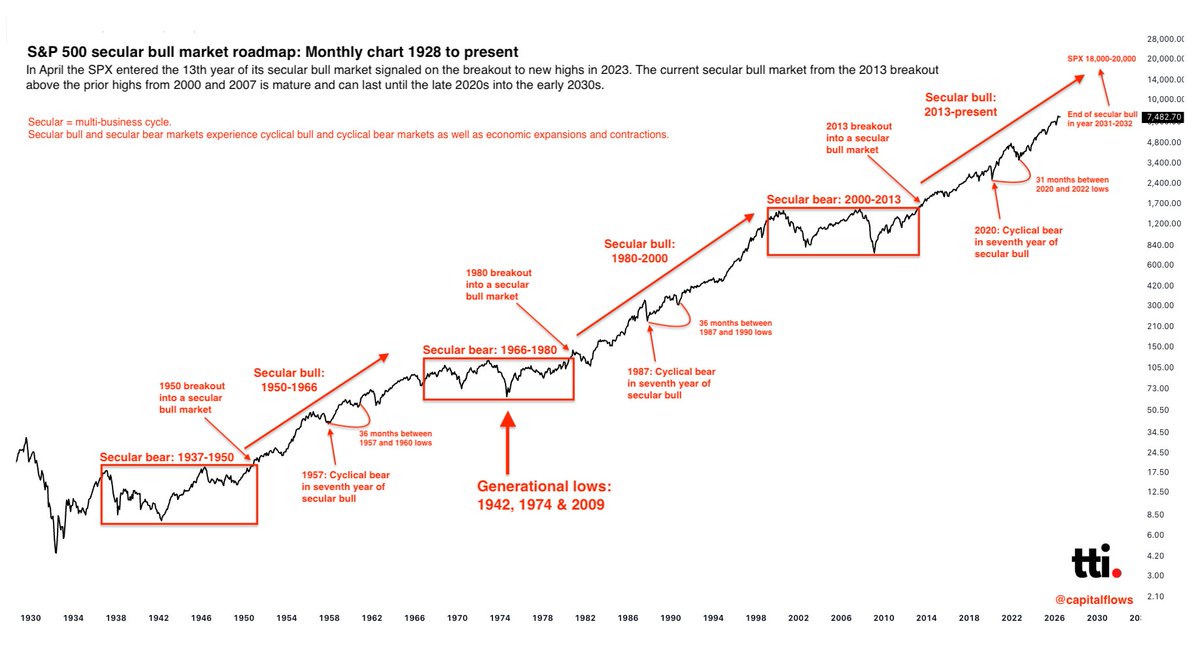
In Today’s Letter The S&P 500 has entered year 13 of its secular bull market. The last two secular bulls lasted 16 and 20 years. A bad storm doesn’t necessarily mean the season has changed. Every Sunday, I like to take a step back from the day-to-day market and think about the bigger picture. Not what might move tomorrow.. But what could shape markets for the next several quarters and years. The ideas that aren’t front and center. The questions most traders aren’t asking yet. This week,...
In Today’s Letter The Magnificent Seven are moving higher again. But they’ve trailed the S&P 500 since November. This week may be the first sign that leadership is changing. If the Magnificent Seven are so strong.. Why have they been losing to the rest of the market? That question might sound strange. After all, the Magnificent Seven have been moving higher for years. They’re some of the largest and most profitable companies in the world. And this week, they rallied nearly 4%. But going up...
In Today's Letter Bank earnings begin next week. Financial stocks are already making new all-time highs. The market may be telling us what to expect. Next week, the biggest banks in America report earnings. JPMorgan. Bank of America. Goldman Sachs. Wells Fargo. By next Friday afternoon, every financial news outlet will tell you who beat estimates and who didn't. But here's the question I can't stop thinking about.. If traders were truly worried about bank earnings.. why are they buying bank...