Retail doesn't move markets. Institutions do.. and they don't post about it. I'm Hamilton. 17 years trading, three bear markets, still standing. Every morning before the open I show you where the big money's actually moving.. what it's buying, what it's leaving, and what I'm doing about it. 3 minutes, free. The next big move, we're in it instead of reading about it.
Software’s Unexpected Victory
|
Software was the trade nobody wanted. The headlines had it buried. AI was going to eat it alive. The $500 billion in private credit propping up the software economy was going to rot from the inside. The poster child for that fear was Oracle.. so loaded with AI debt that its credit default swaps hit a record and the rating agencies started whispering about junk. The most leveraged balance sheet in big software, and in September it was the first to crack.. the rest of the group followed it down. Every strategist on TV (and X) agreed this was the start of something ugly. Lo and behold.. software bottomed this spring. And it hasn't looked back since. In May the recovery was clearly over.. it became the leader. More on that in a second. That wasn't luck. That was reflexivity. And once you understand it, you stop being the person who sells the bottom and start being the person who buys it. Price moves first. The story comes second. Back in February I walked you through this in a piece called The Reflexivity Trap: Bearish Narratives and Doom Loops. If you missed it, go back and read it.. it's the lens for everything below. Here's the short version. George Soros built one of the greatest track records in history on a single idea. Markets don't passively reflect reality. They shape it. Prices fall. Falling prices create fear. Fear creates bearish narratives. Bearish narratives push more people to sell. More selling drives prices lower.. which creates more fear. The loop feeds itself all the way down, until the last seller is gone and there's no one left to scare. Then it flips, and the same loop runs in reverse on the way up. The doom story isn't the cause of the decline. It's a symptom of it. By the time someone publishes the 5,000 word essay on why software is finished, the selling that created the gloom is mostly already done. That's the trap. The story feels most convincing right at the bottom. So how do you actually use this to make money? The same way we just did with software. Three rules. We don't catch the falling knife. When price is dropping and the narratives are piling on, the loop is still running. Standing in front of it is how you get cut. In March, that's exactly where software was. We wait for the loop to exhaust itself. Not on a hunch.. on the data. When institutional capital stops leaving a beaten down group and quietly starts coming back, the selling is running out of fuel. That shift shows up in capital flow long before it shows up in the headlines. We position when the data confirms the turn. Not when it feels safe. It never feels safe at the bottom. That's the whole point. When our Flow Score flipped software from distribution to accumulation from the low 20s into the upper 70s, we moved. And here's what almost nobody noticed.. Over the last two months, the noise has been about semiconductors. The AI bubble. Nvidia. Talk of 1999 all over again. That's where the attention went, and that's where the fear went. Yet software was the AI trade hiding in plain sight. No bubble headlines. No panic. Just institutional capital rotating in while everyone stared at the chips. So while the crowd argued about a semiconductor bubble, we were hunting for the leader inside software. And in May the scoreboard settled it.. software didn't just keep pace with semis, it beat them, and left the S&P behind. That's exactly why we follow flow, not narratives. The loudest trade isn't always the leading trade. The data showed where the money was actually going.. the headlines were busy somewhere else. This is where we put our Flow Score to the test. On May 7, we found the leader we'd been hunting. Oracle. We bought Oracle calls expiring in September and sat in them as the move developed. Yesterday we sold the double. Half the position came off at a 100% gain, which covers our entire original cost. What's left is a free position now.. zero dollars of our own money still at risk, riding the software leader straight into the fall. Oracle ran 38% in May and just closed at a fresh yearly high, while most of the market was still debating whether the rally was real. Now think about this.. that same Oracle.. the first software name to crack wide open in software.. was also the first to heal. It bottomed in early February, two full months before the group found its low in April. The stock is up roughly 65% from that low. Worst story, first to turn.. because capital turns before the narrative can explain why. That's reflexivity in the flesh. That's the whole playbook in one trade. February: the reflexivity call, software on the watch list. May 7: buy the leader. Yesterday: sell the double and ride the rest for free. Here's the part that matters for you. The crowd waits for the narrative to feel safe before it buys. By then the easy money is gone.. they're buying your exit. Reflexivity is how you get there first. You follow the capital, not the story. Software was dead in March according to everyone. We were buying shortly afterwards. That's how you win this game. Profits Over Prophets, Hamilton PS.. The software leg was set up months ago in the data, and our Market Blueprint members had the Flow Score and the trade before the rally made it obvious. The next group flipping from distribution to accumulation is already showing up on our screens. See what the Flow Score is pointing at right now → |
The Trading Initiative
Retail doesn't move markets. Institutions do.. and they don't post about it. I'm Hamilton. 17 years trading, three bear markets, still standing. Every morning before the open I show you where the big money's actually moving.. what it's buying, what it's leaving, and what I'm doing about it. 3 minutes, free. The next big move, we're in it instead of reading about it.
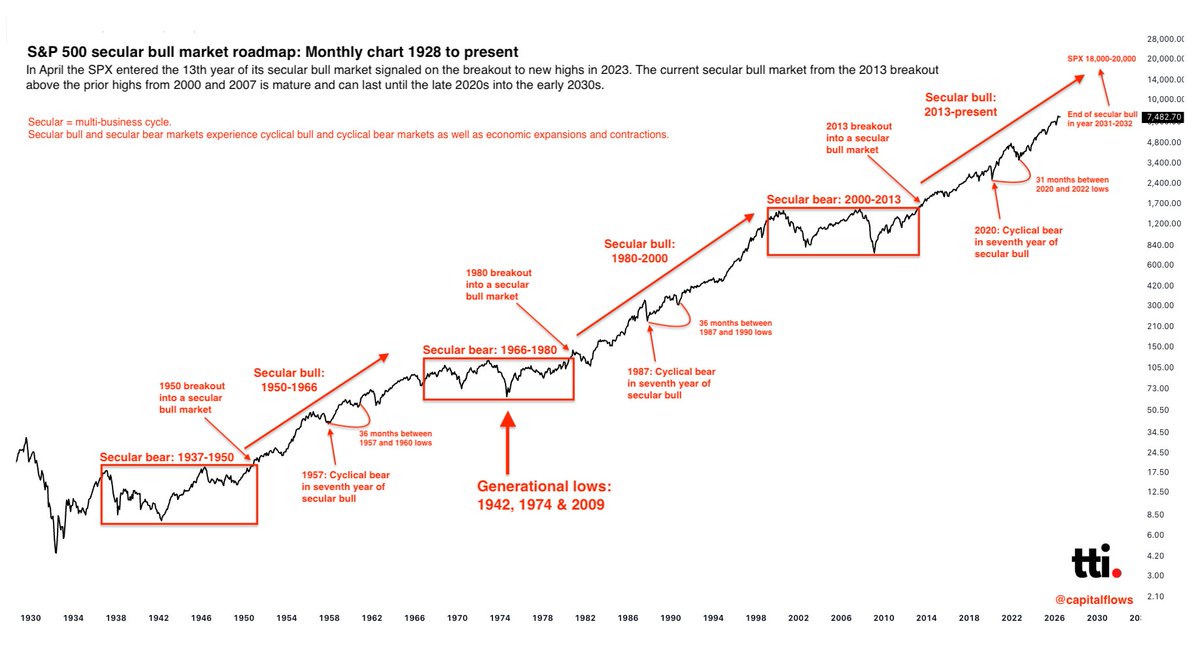
In Today’s Letter The S&P 500 has entered year 13 of its secular bull market. The last two secular bulls lasted 16 and 20 years. A bad storm doesn’t necessarily mean the season has changed. Every Sunday, I like to take a step back from the day-to-day market and think about the bigger picture. Not what might move tomorrow.. But what could shape markets for the next several quarters and years. The ideas that aren’t front and center. The questions most traders aren’t asking yet. This week,...
In Today’s Letter The Magnificent Seven are moving higher again. But they’ve trailed the S&P 500 since November. This week may be the first sign that leadership is changing. If the Magnificent Seven are so strong.. Why have they been losing to the rest of the market? That question might sound strange. After all, the Magnificent Seven have been moving higher for years. They’re some of the largest and most profitable companies in the world. And this week, they rallied nearly 4%. But going up...
In Today's Letter Bank earnings begin next week. Financial stocks are already making new all-time highs. The market may be telling us what to expect. Next week, the biggest banks in America report earnings. JPMorgan. Bank of America. Goldman Sachs. Wells Fargo. By next Friday afternoon, every financial news outlet will tell you who beat estimates and who didn't. But here's the question I can't stop thinking about.. If traders were truly worried about bank earnings.. why are they buying bank...